Project Page
Learning Task-Centric World Models from Visual Foundations
University of California, San Diego
World models enable agents to predict future dynamics conditioned on actions, making the choice of latent representation central to planning and control. Such representations are often either learned directly from pixels with limited semantic structure or inherited from frozen visual foundation models with excessive task-irrelevant detail, yielding state spaces that are poorly matched to downstream planning and control. This is especially challenging in reward-free offline settings, where the model must learn from fixed trajectories without reward supervision or online interaction.
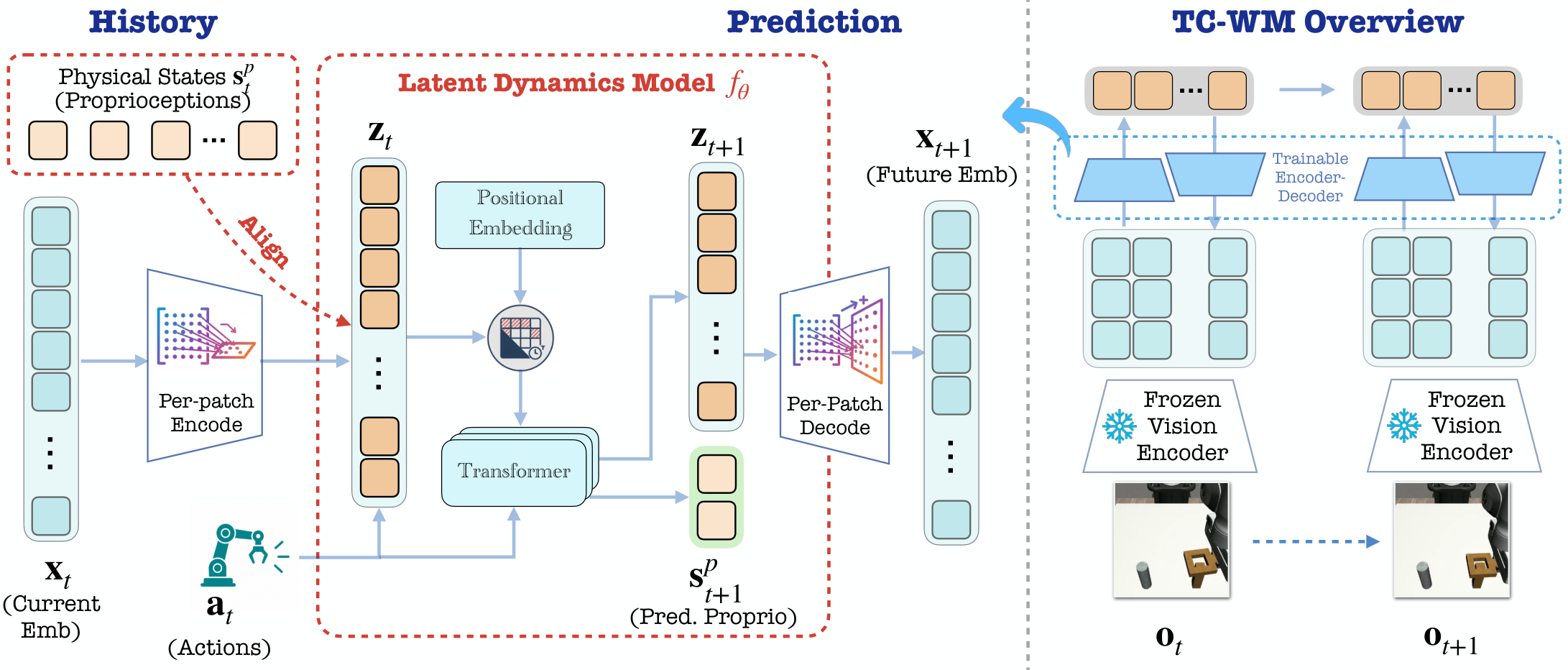
To address this, we propose TC-WM, a framework for turning foundation-model embeddings into compact, task-sufficient world representations. The key design is to treat the pretrained embedding space as a semantic scaffold rather than as the final state space: TC-WM linearly projects high-dimensional visual embeddings into a compact latent as the dynamic space, aligns a subspace with the agent's physical state via contrastive learning, and reconstructs embeddings to preserve useful visual structure. This combines the generality of foundation features with the controllability of task-centric dynamics. Theoretically, we show that TC-WM suffices to identify the task-centric latent factors up to a simple transformation. Empirically, TC-WM enables test-time planning across diverse environments (e.g., Robomimic and D4RL), achieving better world-modeling quality and more precise control than state-of-the-art approaches.
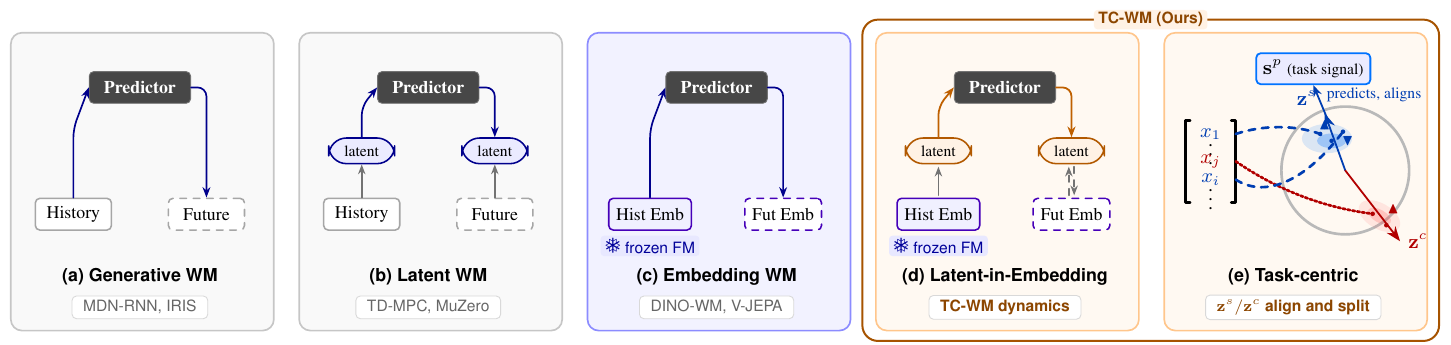
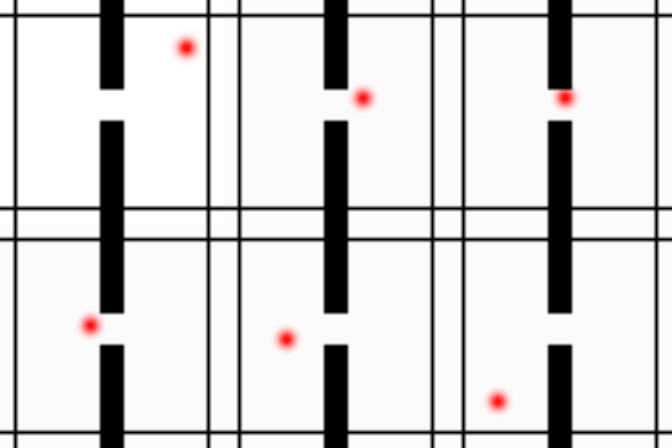
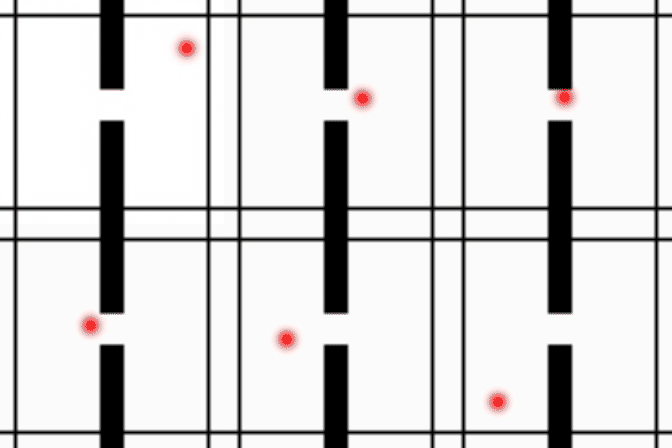
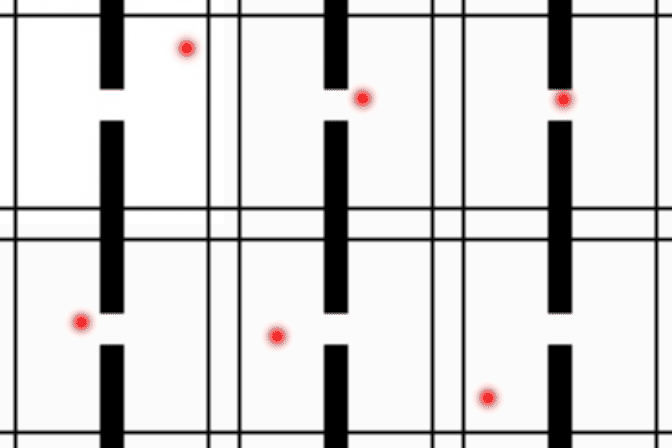
TC-WM splits its compact latent into a task-centric part zs and a contextual part zc. The glow marks where a block drives the predicted change — pick a task and block to compare.
Reading the glow. A saliency map: where advancing only that latent block one step changes the decode.
Frozen foundation embeddings describe how a scene looks. Planning and control need a state: a compact handle on the factors an action can change. TC-WM recovers one with a single linear projection inside the embedding.
Figure 1: Comparison of world-model paradigms. (a) Generative WM (MDN-RNN, IRIS) โ predict pixels directly. (b) Latent WM (TD-MPC, MuZero) โ predict in a learned latent. (c) Embedding WM (DINO-WM, V-JEPA) โ predict in a frozen foundation embedding. (d) TC-WM dynamics โ predict in a compact latent inside the embedding. (e) Task-centric structure โ align zs with proprioception, anchor zc via embedding reconstruction.
Architecture. A frozen visual backbone is linearly projected into a compact latent; a designated subspace is aligned with proprioception via InfoNCE; a ViT predicts latent dynamics; a linear decoder reconstructs the embedding to prevent collapse. Under partial alignment, the task-centric block is identifiable up to an affine map.
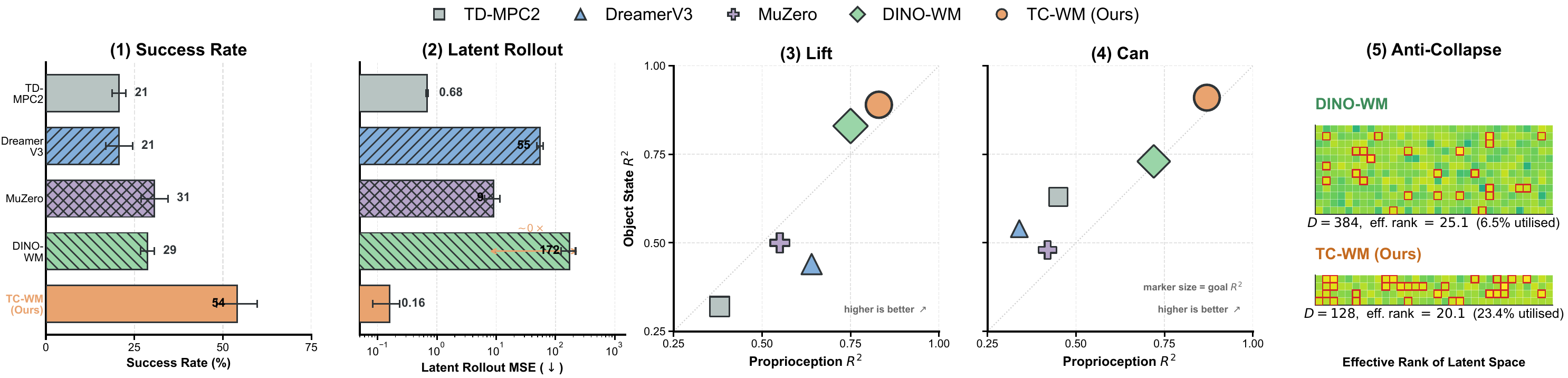
A single linear projection of frozen DINOv2 embeddings gives the lowest latent-rollout error across nine tasks. Predicting in a parsimonious latent is more accurate than predicting in the raw embedding.
Aligning a latent subspace with proprioception is the only method that surpasses DINO-WM on every Robomimic task, giving more precise control.
Alignment concentrates the dynamic latent on the gripper and manipulated object. Without it, the influence spreads across the whole scene.
Figure 2: Robomimic highlight. (1) Success rate. (2) Latent-rollout MSE. (3–4) Linear probes on Lift and Can. (5) TC-WM avoids the latent collapse seen when rolling out directly on foundation embeddings.
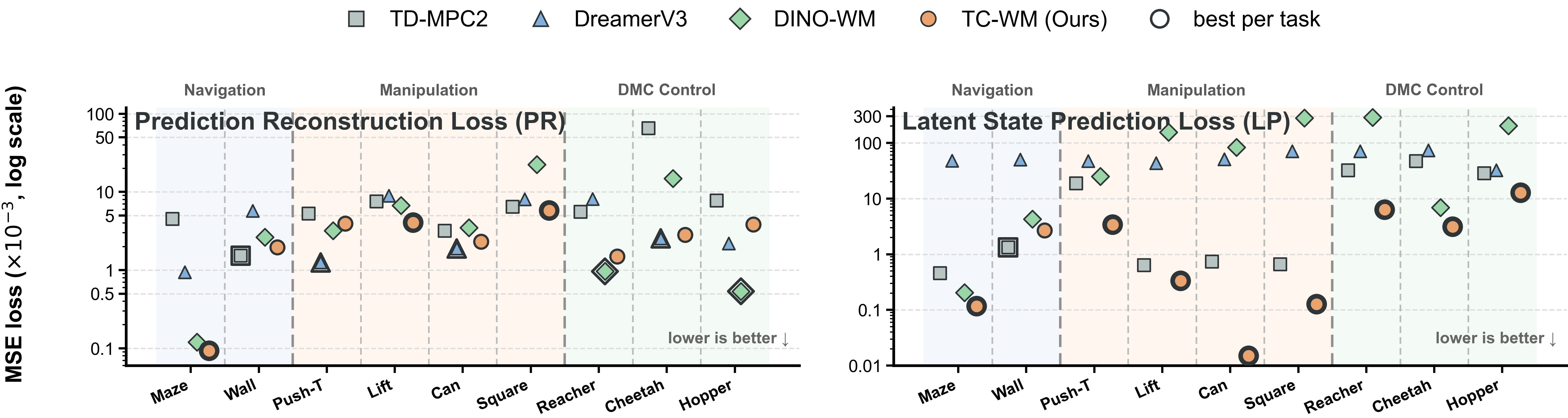
World-model prediction. Lowest latent-prediction error on nearly all tasks; competitive image reconstruction. Lower is better.
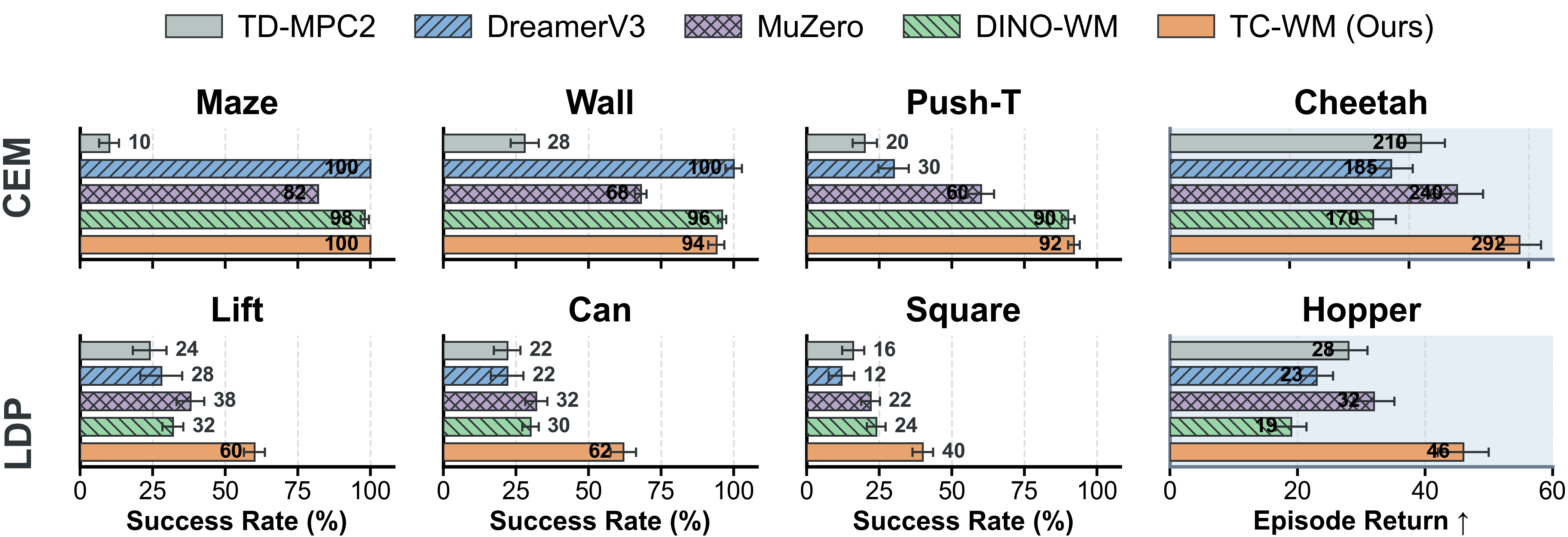
Planning. CEM on Maze / Wall / Push-T / Cheetah / Hopper; LDP on Lift / Can / Square. Only method that surpasses DINO-WM on every LDP task.
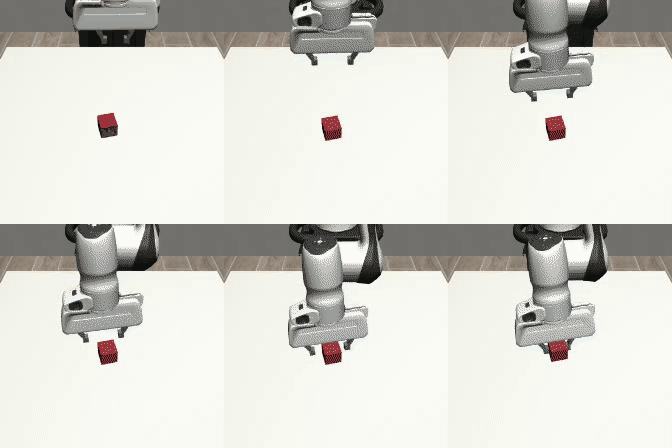
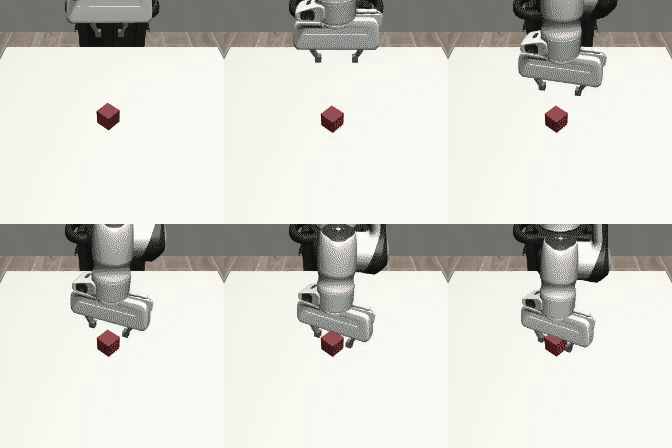
clean input
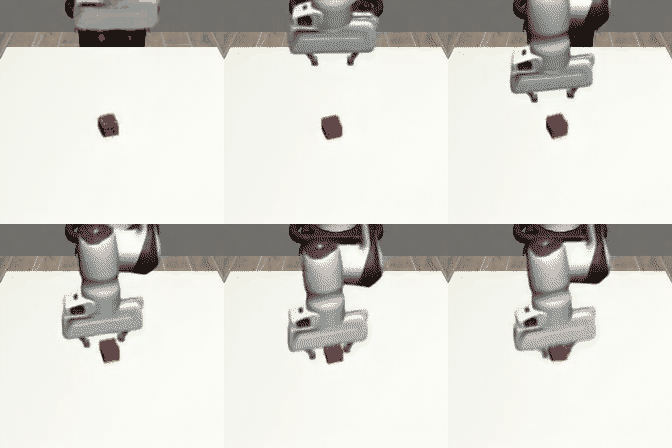
TC-WM pred (clean)
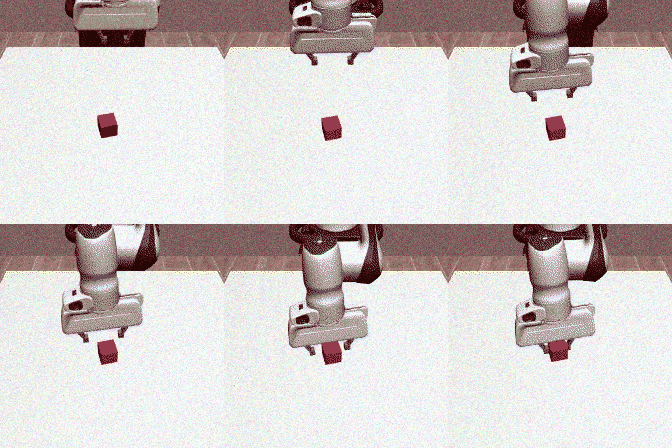
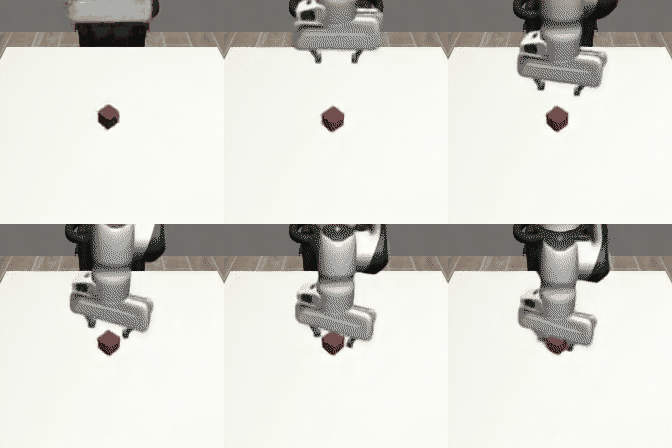
noisy input
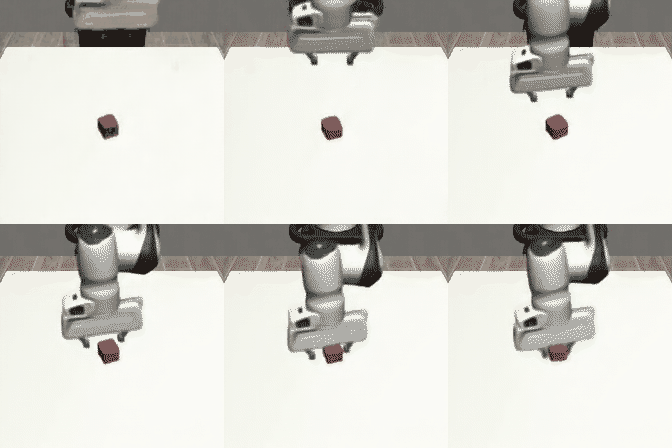
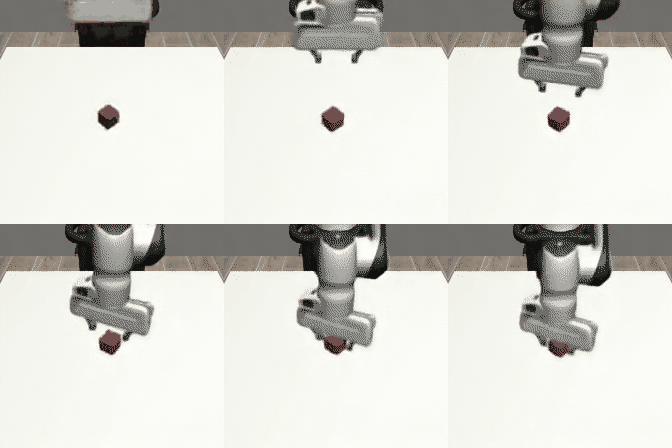
TC-WM pred (noisy)Lift · Gaussian noise + color jitter
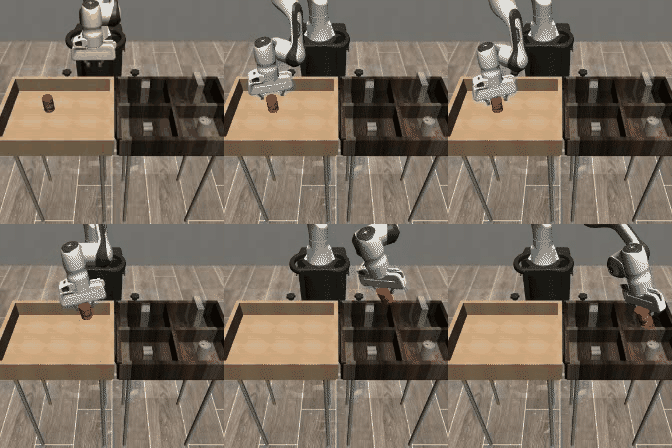
Unseen perturbations. Under additive Gaussian noise and per-channel color jitter never seen during training, TC-WM's open-loop rollout preserves cube position and manipulator silhouette at near-clean fidelity.
original
reconstruction
rolloutLift
original
reconstruction
rolloutCan
original
reconstruction
rolloutSquare
original
reconstruction
rolloutWall
original
reconstruction
rolloutMaze
original
reconstruction
rolloutCheetah
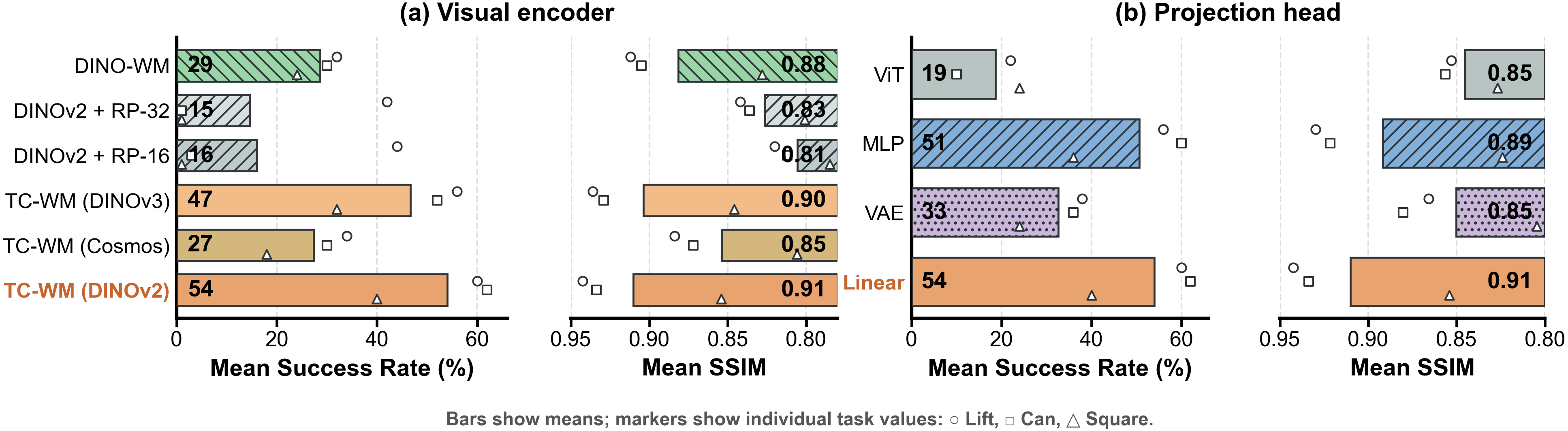
Architecture / projection ablations on Robomimic. Visual encoder / latent-source choice (a) and projection-head ablation (b), each showing success rate on the left and mirrored SSIM on the right. RP denotes randomly projected DINOv2 embeddings. Linear projection is the best; DINOv2 and DINOv3 dominate as foundation encoders.
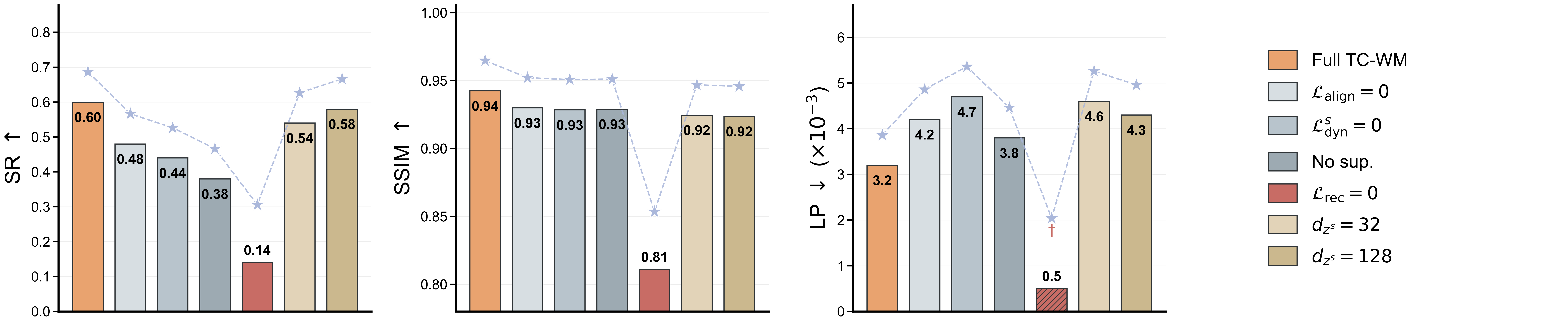
Loss components on Lift. Removing embedding reconstruction collapses both planning and visual fidelity; removing proprioceptive supervision lowers success rate while preserving SSIM; the latent split dimension matters little.
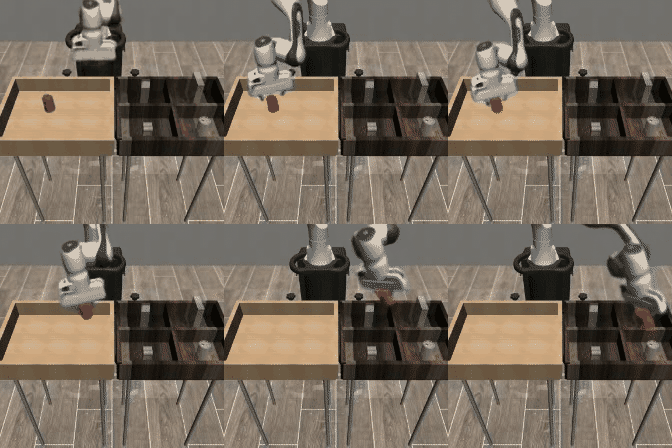
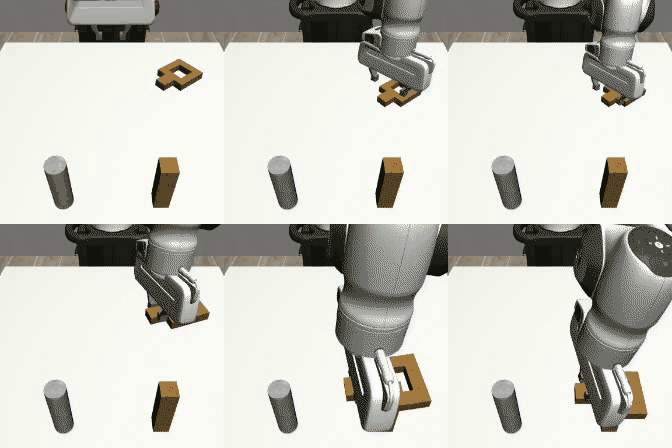
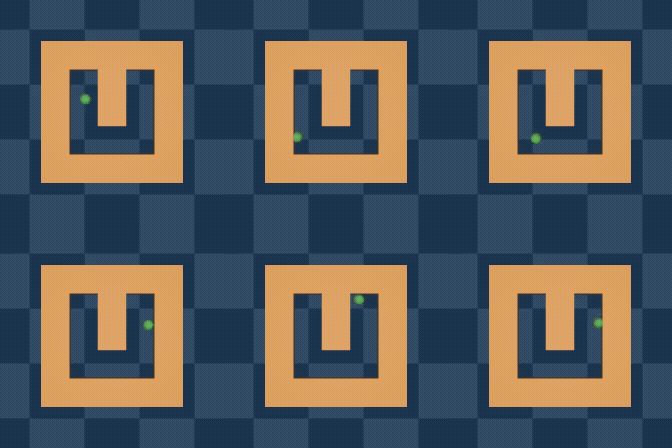
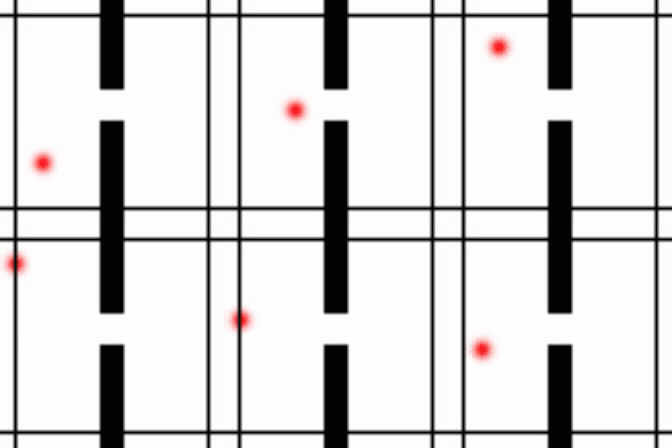
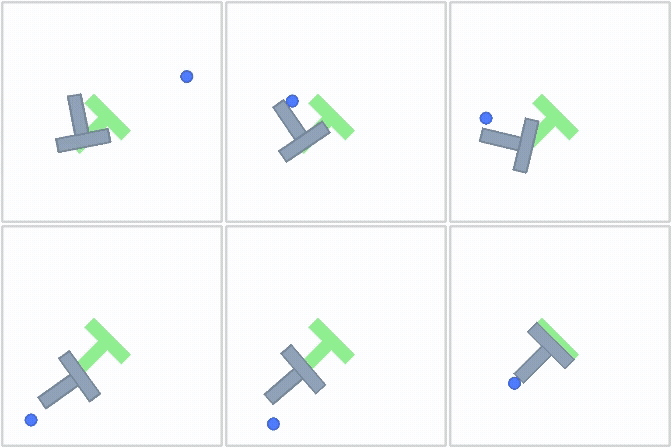
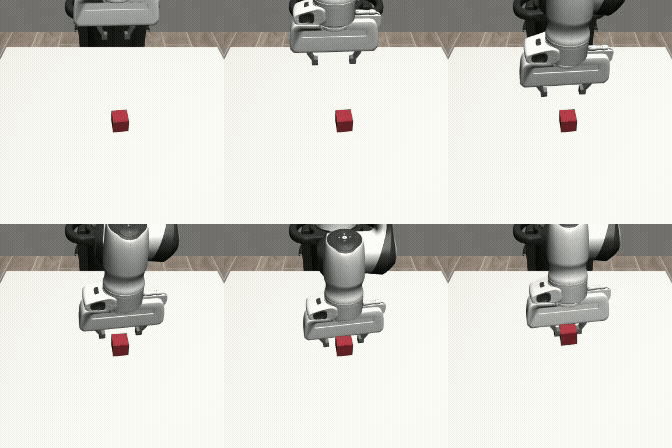
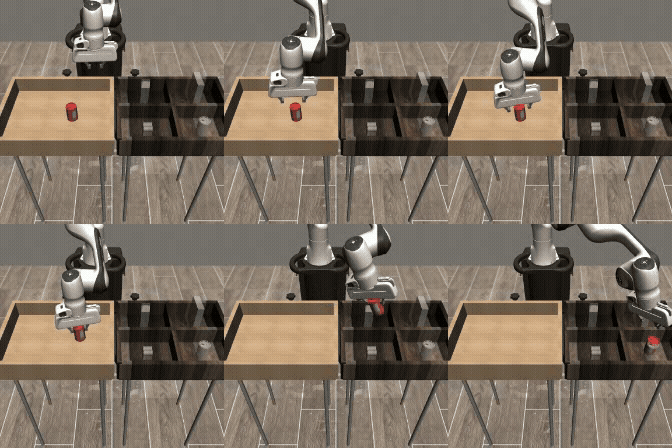
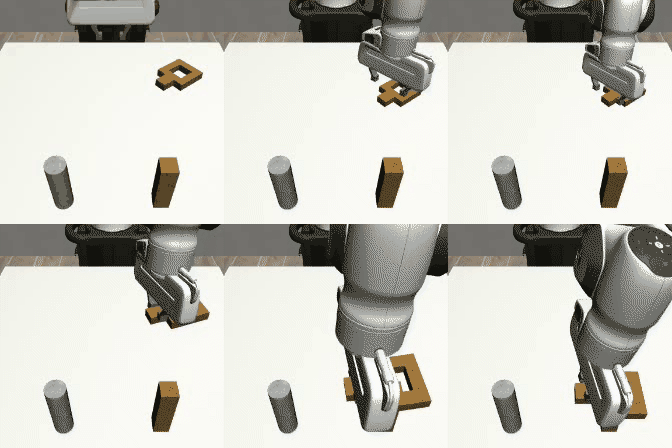
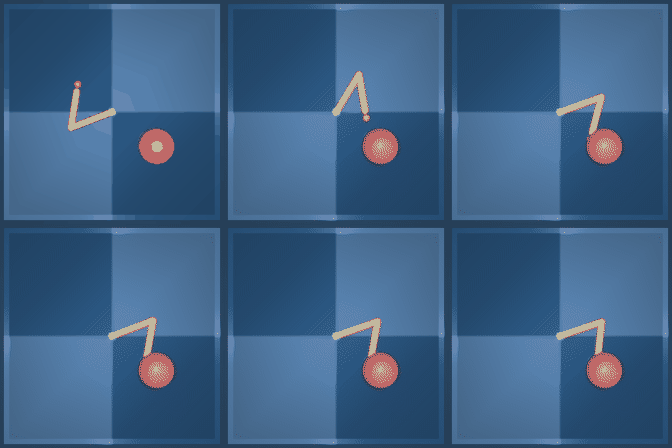
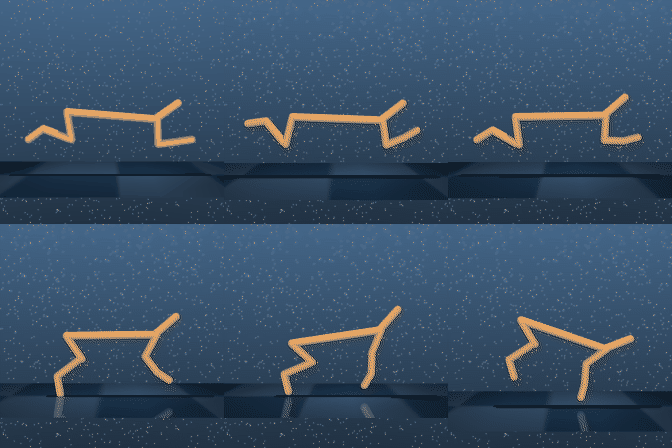
Nine offline visual-control tasks: navigation, locomotion, and manipulation. We use images, actions, and proprioception during training, without reward.
Maze
Wall
Push-T
Lift
Can
Square
Reacher
Cheetah
Hopper
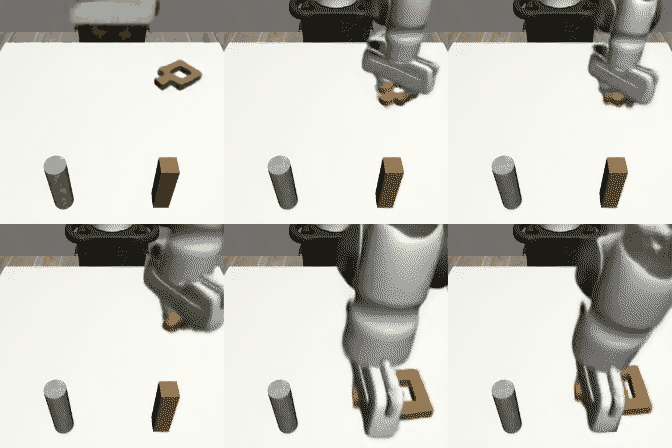
The method is not specific to DINOv2 or to simulation. We finetune Cosmos3-Nano, a 16B video foundation model, with the task-centric objective — denoted TC-Cosmos3 — and evaluate it on real DROID robot episodes. Each clip is conditioned on identical ground-truth actions from a common start frame, so any divergence reflects the world model rather than the policy: Ground truth · TC-Cosmos3 · Cosmos3-Nano.
Put the blocks into the bowl, then wipe the table
Remove the cables from the plastic bag and put them on the table
Plug the charger head into the adapter
Put the black bottle and the sponge on the top shelf
Remove the screwdriver from the rack and put it in the cup
Real-robot video rollouts. Each panel stitches three camera views (wrist on top, two exterior below). TC-Cosmos3 stays anchored to the gripper and the manipulated object while letting non-interacting background vary — the same disentanglement measured in simulation, now carried by a 16B video model on real hardware.

@article{fu2026tcwm,
title = {Back to Parsimonious Latents: Learning Task-Centric World Models from Visual Foundations},
author = {Fu, Minghao and Feng, Fan and Hansen, Nicklas and Huang, Biwei},
journal= {arXiv preprint arXiv:2605.25620},
year = {2026}
}